
mushroom education
Mushroom Spores Explained: Understanding Fungal Reproduction and Microscopy
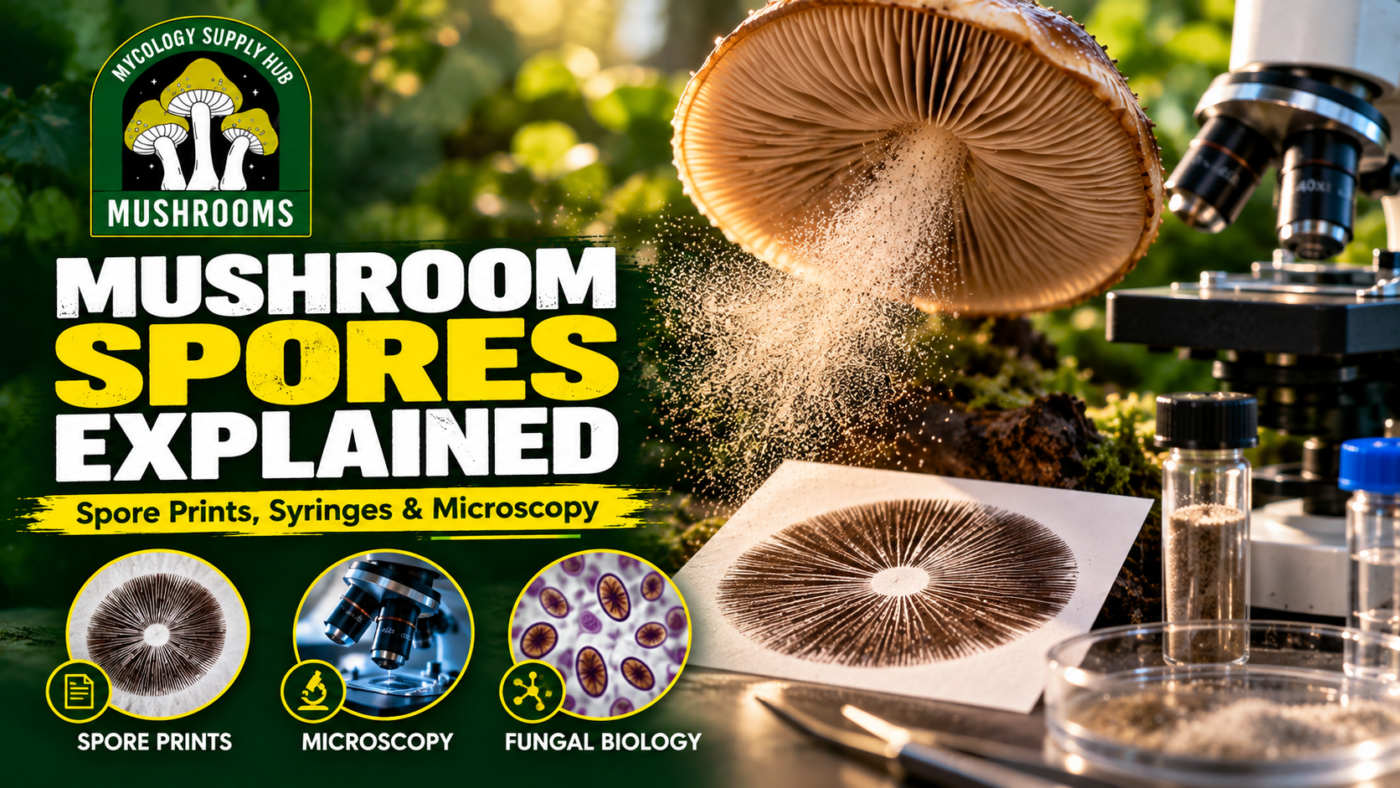
Oct
Mushrooms are among nature’s most fascinating organisms. They play essential roles in decomposition, nutrient cycling, biodiversity and ecological balance. One of the most important features of their biology is their ability to produce microscopic reproductive units called mushroom spores.
Whether you’re interested in edible mushrooms, fungal genetics, spore prints or mushroom microscopy, understanding spores provides a foundation for studying the world of fungi.
Unlike flowering plants, fungi do not reproduce using flowers or botanical seeds. Many fungal species produce specialised spores that contribute to reproduction, dispersal and survival.
In this educational guide, Mycology Supply Hub explains what mushroom spores are, how they function, why mycologists study them and how different forms of fungal research material compare.
2. What Are Mushroom Spores?
Mushroom spores are microscopic reproductive units produced by fungi.
They contain genetic material and, under suitable biological conditions, may develop into fungal structures that participate in the organism’s life cycle.
Spores are sometimes compared to plant seeds because they help fungi reproduce and spread. However, the comparison is imperfect.
A seed contains a developing plant embryo and stored resources. A fungal spore has a different cellular structure and reproductive role.
Why do mushrooms produce spores?
Spores perform several important biological functions:
- Reproduction and continuation of the fungal life cycle.
- Dispersal to new environments.
- Genetic variation through sexual reproductive processes.
- Persistence through environmental changes in some species.
- Population expansion and biodiversity.
The University of Florida’s Institute of Food and Agricultural Sciences explains how spore deposits provide useful evidence in mushroom identification.
UF/IFAS Extension Orange County
3. How Do Mushroom Spores Work?
To understand mushroom spores, it helps to understand the general life cycle of a typical gilled basidiomycete fungus.
Simplified mushroom life cycle
SporesMicroscopic reproductive units
Hyphae and myceliumDevelopment of fungal filaments and networks
Fruiting bodyReproductive mushroom structure
Spore releaseThe reproductive cycle continues
This is a simplified model. Many basidiomycetes also undergo hyphal fusion and distinct nuclear stages before developing fruiting bodies.
Spore germination
In suitable conditions, spores of many fungal species can germinate and develop filament-like structures known as hyphae.
Development of mycelium
Hyphae form networks called mycelium. These networks help fungi obtain nutrients and interact with their environments.
Mushroom formation
For mushroom-forming fungi, a reproductive fruiting body may develop as part of the life cycle.
Spore production and dispersal
The mature reproductive structures produce spores, which may be carried by air currents, water or other environmental processes.
Not all fungi follow the same reproductive pattern. Some reproduce in other ways or have multiple reproductive stages.
4. What Is a Mushroom Spore Print?
A mushroom spore print is a visible deposit of spores released from a mushroom’s reproductive surface.
In many gilled species, spores collect in a pattern reflecting the arrangement of the mushroom’s gills.
Spore prints can reveal colours ranging from white and cream to pink, brown, purple-brown or black, depending on the species.
Why are spore prints important?
Spore prints can support:
- Fungal taxonomy and classification.
- Classroom demonstrations of fungal reproduction.
- Documentation of spore pigmentation.
- Comparative studies of related mushroom groups.
- Educational understanding of reproductive anatomy.
A spore print does not definitively identify a species. Different mushrooms can produce similar print colours, including some poisonous species.
The University of Florida Extension provides an educational introduction to spore prints and their scientific importance.
UF/IFAS Extension Orange County
5. What Is a Mushroom Spore Syringe?
A mushroom spore syringe is a container used to hold a liquid suspension of fungal spores.
In mycology literature and commercial terminology, the phrase generally refers to spores suspended in water rather than an actively growing fungal culture.
Because the spores are microscopic, a liquid suspension may appear relatively clear even when fungal reproductive material is present.
Spore syringes and scientific study
Spore suspensions may be discussed in connection with:
- Microscopic observation.
- Comparative fungal morphology.
- Spore pigmentation and structural characteristics.
- Research documentation.
- Taxonomic education.
The appearance of a spore suspension does not independently verify its identity, purity or safety.
Important distinction: A spore syringe is not the same as a liquid culture syringe. They contain different biological material.
6. Mushroom Spore Syringe vs Liquid Culture Syringe
These two terms are often confused.
A spore syringe typically contains spores suspended in liquid, whereas a liquid culture contains living fungal mycelium in a nutrient-containing medium.
Fungi.org
+1
| Feature | Spore syringe | Liquid culture syringe |
|---|---|---|
| Biological content | Fungal spores | Living mycelium |
| Material type | Spore suspension | Active fungal culture |
| Life-cycle stage | Reproductive cells | Developed vegetative tissue |
| Genetic characteristics | May contain multiple genetic individuals | Depends on the culture’s origin |
| Microscopy relevance | Spore morphology | Hyphal morphology |
| Scientific purpose | Reproductive biology and taxonomy | Fungal physiology and culture studies |
The two materials should not be represented as interchangeable.
A liquid culture is also not necessarily a single genetic clone; its composition depends on how it originated.
For edible and non-controlled fungi, both concepts are relevant to understanding applied mycology. Different legal restrictions may apply to controlled species and living cultures.
7. Mushroom Spores Under the Microscope
Microscopy is fundamental to fungal taxonomy.
Many fungal characteristics cannot be assessed reliably through photographs or ordinary visual observation.
Researchers may examine:
Spore shape
Fungal spores can be spherical, elliptical, elongated or irregularly shaped.
Spore dimensions
Spore measurements are useful in distinguishing certain taxa when evaluated together with other evidence.
Surface ornamentation
Some spores have smooth surfaces, while others exhibit ridges, projections or specialised patterns.
Spore pigmentation
Pigmentation can provide additional taxonomic information.
Reproductive structures
Basidia, cystidia and other microscopic features may be important when classifying gilled mushrooms.
Microscopy is especially valuable when visible mushroom characteristics overlap among related species.
However, microscopy alone may not resolve every taxonomic question. Modern fungal classification often combines microscopic observations with DNA analysis.
8. Mushroom Spores vs Mushroom Seeds
The search phrase psilocybin mushroom seeds sometimes appears in online discussions, but it is scientifically inaccurate.
Mushrooms are fungi, not seed-bearing plants.
| Mushroom spores | Plant seeds |
|---|---|
| Produced by fungi | Produced by seed-bearing plants |
| Often single reproductive cells | Multicellular structures containing embryos |
| May be produced in enormous quantities | Production varies by plant species |
| Participate in fungal life cycles | Participate in plant life cycles |
| Do not contain a plant embryo | Contain an embryonic plant |
Using scientifically accurate terminology improves the quality of educational articles and helps readers better understand fungal biology.
9. Why Mushroom Spores Matter in Scientific Research
Fungal biodiversity
Spores help scientists distinguish and document diverse fungal taxa.
Environmental monitoring
Airborne fungal spores can be studied in ecology, agriculture and environmental health.
Plant and fungal pathology
Certain fungal spores are involved in diseases that affect crops, forests and other plants.
Medical mycology
Some fungal spores are relevant to respiratory exposure and fungal infections, especially in vulnerable populations.
Evolutionary biology
Spore characteristics provide evidence that can complement molecular research into fungal relationships.
10. Mushroom Spore Identification and Safety
Spore appearance alone cannot reliably confirm that a mushroom is edible, non-toxic or correctly labelled.
Some poisonous mushrooms share visible features with harmless species.
A professional identification may involve multiple lines of evidence, including specimen morphology, microscopy, ecology and genetic analysis.
Anyone with a suspected mushroom poisoning should seek urgent medical help.
It is also important to recognise that fungal spores may act as allergens or cause respiratory concerns under some exposure conditions. Sensitive individuals should avoid unnecessary contact with concentrated airborne fungal material.
11. Frequently Asked Questions About Mushroom Spores
1. What are mushroom spores?
They are microscopic reproductive units produced by fungi.
2. Are mushroom spores the same as seeds?
No. Both can participate in reproduction, but fungal spores and plant seeds have different biological structures.
3. What is a mushroom spore print?
It is a visible deposit of spores released by a mushroom’s reproductive structures.
4. What is a mushroom spore syringe?
It generally refers to fungal spores suspended in liquid within a syringe.
5. What is liquid culture?
Liquid culture contains fungal tissue growing in a nutrient-containing liquid medium.
6. Are spores visible without a microscope?
Individual spores are generally microscopic, although large collections can form visible deposits.
7. Can spore colour identify a mushroom?
Spore colour can support identification, but it cannot independently confirm the species or establish safety.
8. Do all mushrooms produce spores?
Mushroom-forming fungi reproduce through spores, although their reproductive anatomy and life cycles vary.
9. Are mushroom spores dangerous?
Risks depend on the species, exposure level and individual susceptibility. Some spores can cause allergic or respiratory reactions.
10. Why do scientists study mushroom spores?
They are important for studying fungal reproduction, taxonomy, biodiversity, ecology and evolutionary biology.
12. Conclusion
Mushroom spores are fundamental to fungal life cycles and scientific mycology.
From the microscopic structures of individual spores to the visible patterns of spore prints, these reproductive units reveal important information about fungal biology and biodiversity.
Understanding the difference between spores, spore suspensions and living fungal cultures also helps readers interpret mycology terminology accurately.
To explore additional educational content about fungal science, taxonomy and microscopy, visit Mycology Supply Hub.
