mushroom education
What Is Psilocybe Cubensis?
Oct
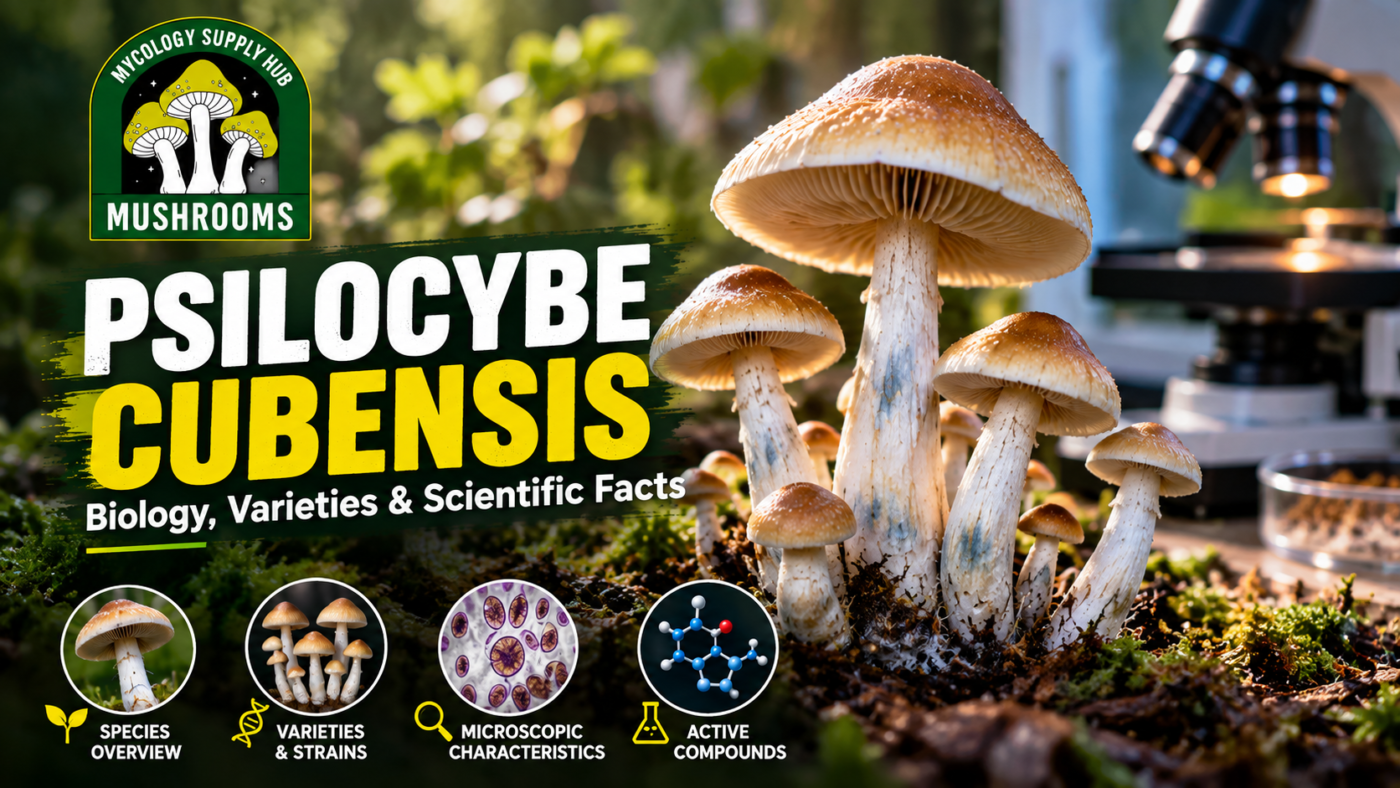
Psilocybe cubensis is one of the best-known species of psilocybin-containing fungi. It has attracted interest among mycologists, taxonomists and researchers because of its distinctive biology, global distribution and production of naturally occurring tryptamine compounds.
Although popularly associated with psychedelic mushrooms, Psilocybe cubensis is also an interesting organism from the perspective of ecology, reproduction, genetics and fungal classification.
This guide explores its scientific background, major biological characteristics, named varieties, chemical compounds and research significance.
Scientific classification of Psilocybe cubensis
The accepted scientific name is Psilocybe cubensis (Earle) Singer. It was originally described under the name Stropharia cubensis in 1906.
NCBI
+1
| Classification | Name |
|---|---|
| Kingdom | Fungi |
| Phylum | Basidiomycota |
| Class | Agaricomycetes |
| Order | Agaricales |
| Genus | Psilocybe |
| Species | Psilocybe cubensis |
Some taxonomic databases differ in their treatment of the family-level classification. This reflects changes in fungal systematics as molecular evidence improves.
Why the scientific name matters
A scientific name provides a more consistent identifier than a popular name. Terms such as magic mushroom, cube mushroom and gold top mushroom may be used informally, but they are not equally precise.
Taxonomy allows scientists to distinguish related organisms and compare their evolutionary relationships.
Natural biology and physical characteristics
Like many gilled mushrooms, P. cubensis produces a visible fruiting body that functions in reproduction.
Its principal structures include:
- Pileus: The cap, which protects the developing spore-bearing surface.
- Lamellae: The gills underneath the cap.
- Stipe: The stem supporting the cap.
- Basidia: Microscopic structures associated with sexual spore production.
- Basidiospores: Reproductive cells involved in the fungal life cycle.
The fruiting body is only one part of the organism. Much of a fungus exists as a network of microscopic filaments called hyphae, which collectively form mycelium.
A scientific review published in Journal of Fungi describes variation in the appearance and microscopic features of P. cubensis specimens.
PMC
These descriptions are useful for research but should not be used as a standalone guide to identifying mushrooms for consumption.
Where does Psilocybe cubensis occur naturally?
Psilocybe cubensis has been documented in multiple parts of the world, particularly in warm regions.
Its ecological role is associated with the decomposition of organic matter and nutrient cycling.
Fungi contribute to ecosystems by breaking down complex organic materials into substances that other organisms can use. Their activities influence soil processes, microbial communities and the cycling of carbon and other nutrients.
Occurrence records are compiled in databases such as the Global Biodiversity Information Facility. These records are valuable for biodiversity research, although observations may contain identification errors.
What are the main varieties of Psilocybe cubensis?
Several well-known names are associated with P. cubensis. They are widely discussed in online communities, but their scientific status requires careful interpretation.
1. Golden Teacher
Golden Teacher is a familiar name associated with P. cubensis.
In popular terminology, it is often described as a strain or variety. However, this does not automatically make it a separately recognised botanical or mycological taxon.
2. Albino Penis Envy (APE)
Albino Penis Envy is another widely used commercial or informal name.
The term albino in an informal mushroom name should not be taken as proof of a particular genetic mechanism without supporting evidence.
It is useful to distinguish appearance-based naming conventions from documented hereditary traits.
3. B+
B+ is another commonly recognised P. cubensis designation.
Like other informal names, it may refer to a particular lineage or selection history without establishing a distinct species.
4. Other named forms
Other commonly discussed names include Thai Cubensis and Texas Yellow. Research has examined chemical variation among labelled specimens, but those labels should not be considered reliable predictors of composition or effects.
MDPI
What chemicals are found in Psilocybe cubensis?
Scientific interest in this species is largely connected to several naturally occurring compounds.
Psilocybin
Psilocybin is a phosphorylated tryptamine compound that is converted into psilocin in the human body.
Psilocin
Psilocin interacts with serotonin receptors, including the 5-HT2A receptor, and contributes to the characteristic psychoactive effects associated with psilocybin-containing fungi.
Other compounds under investigation
Scientists have also studied related compounds, including baeocystin and norbaeocystin.
The presence and quantities of individual compounds can vary between specimens, so species labels or informal variety names cannot establish precise chemical content.
Psilocybe cubensis vs other Psilocybe species
| Species | Scientific distinction |
|---|---|
| Psilocybe cubensis | Widely documented species associated with warm environments |
| Psilocybe cyanescens | Distinct species with different ecological associations |
| Psilocybe semilanceata | Species commonly known as the Liberty Cap |
| Psilocybe azurescens | Separate species studied for its chemistry and taxonomy |
| Psilocybe natalensis | An African Psilocybe taxon of ongoing scientific interest |
These are separate scientific names, not interchangeable commercial varieties.
A study published in Applied and Environmental Microbiology demonstrated that misidentification can occur even in scientific specimen collections. DNA-based analysis helped reveal inconsistencies between some specimen labels and their actual taxonomic relationships.
Applied and Environmental Microbiology
Why is Psilocybe cubensis important in modern research?
Fungal genetics
DNA sequencing helps researchers investigate the evolutionary relationships between mushroom species and examine genetic variation.
Natural product chemistry
Researchers study the biochemical pathways responsible for the production of compounds such as psilocybin.
Neuroscience
Psilocybin has been investigated in controlled studies relating to brain activity, perception and mental health.
Taxonomic accuracy
Molecular analysis is improving the quality of fungal identification and challenging classifications based only on physical appearance.
These areas of research demonstrate why mycology requires contributions from biology, chemistry, genetics and environmental science.
Safety and legal considerations
Psilocybe cubensis contains psychoactive substances, and its possession, production or distribution may be restricted depending on jurisdiction.
Psychoactive effects can be unpredictable. Potential risks include anxiety, confusion, impaired judgement and adverse psychological reactions.
Additionally, some poisonous mushrooms can resemble psychoactive species. Colour, appearance, a photograph or a popular species description cannot establish that a specimen is safe to consume.
Readers should consult qualified professionals and relevant authorities when seeking health or legal information.
Frequently asked questions about Psilocybe cubensis
1. What is Psilocybe cubensis?
It is a species of fungus known for naturally producing psilocybin and related compounds.
2. Is Psilocybe cubensis a plant?
No. It belongs to the kingdom Fungi, which is biologically distinct from the plant kingdom.
3. Is Golden Teacher a separate mushroom species?
No. Golden Teacher is an informal name associated with Psilocybe cubensis, not an independently recognised species.
4. Are all Cubensis varieties chemically identical?
No. Chemical composition can vary, and informal names do not reliably establish specific concentrations.
5. Does Psilocybe cubensis produce spores?
Yes. As a basidiomycete fungus, it forms reproductive basidiospores.
6. What does P. cubensis mean?
P. abbreviates the genus Psilocybe. The species epithet cubensis refers to Cuba, where the species was originally described.
7. Can Psilocybe cubensis be identified from an image?
A photograph alone is insufficient to verify a mushroom’s identity or safety.
8. Why do scientists study Psilocybe cubensis?
It is relevant to research in fungal biodiversity, chemical biology, molecular genetics and neuroscience.
Conclusion
Psilocybe cubensis is a significant species in the scientific study of fungi. Its classification, reproduction, chemistry and genetic variation illustrate the biological complexity of mushrooms.
For researchers and readers interested in mycology, the species provides a useful introduction to fungal taxonomy and the ways scientific evidence can distinguish established facts from informal naming practices.
Explore more educational guides at Mycology Supply Hub.
psilocybe cubensis mushroom
psilocybe cubensis mushroom psilocybe cubensis mushroom psilocybe cubensis mushroom psilocybe cubensis mushroom psilocybe cubensis mushroom psilocybe cubensis mushroom
