mushroom education
Psilocybe Cyanescens Habitat: A Scientific Guide to Wavy Cap Mushrooms
Oct
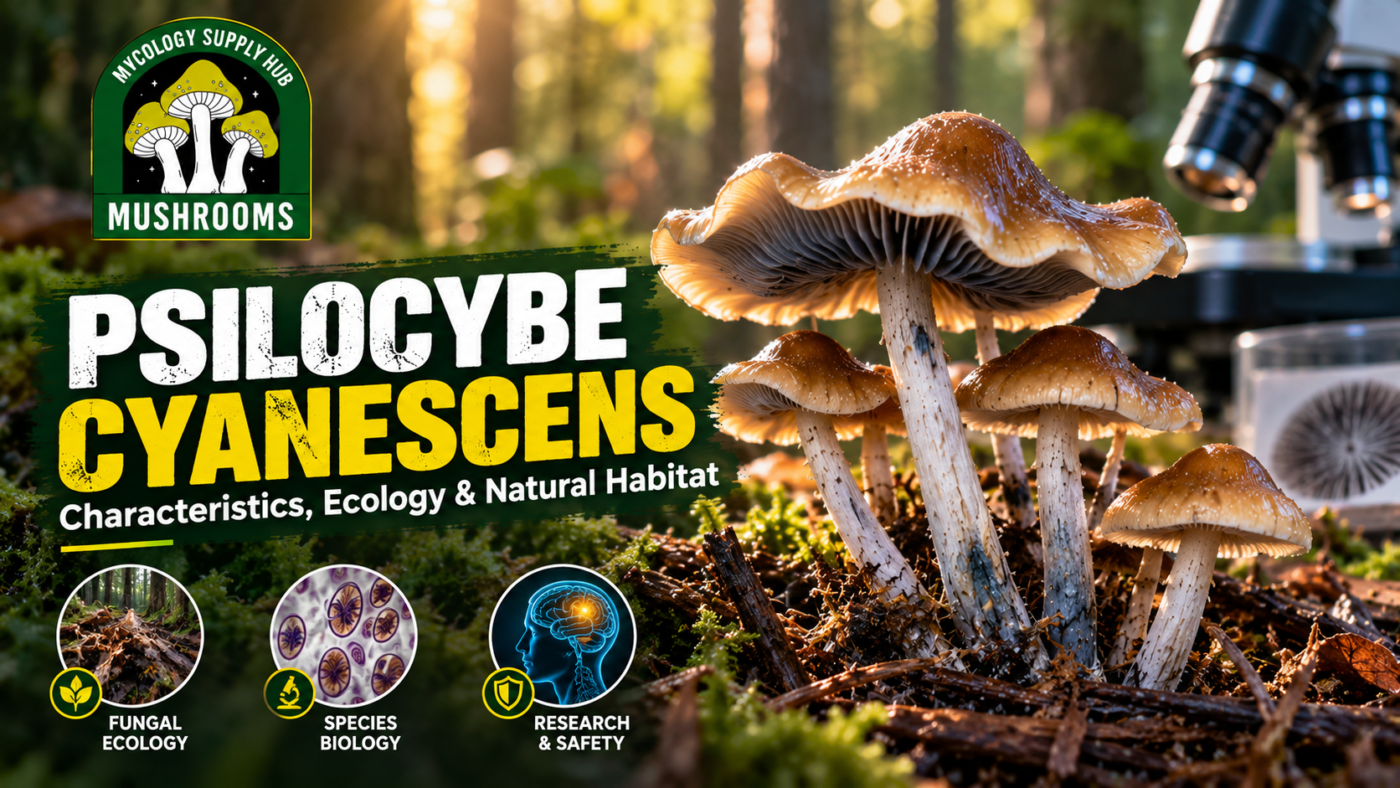
Psilocybe cyanescens, commonly called the Wavy Cap mushroom, is a species of fungus recognised for its distinctive cap shape, wood-decaying ecology, and naturally occurring psychoactive compounds.
Understanding Psilocybe cyanescens habitat is important for studying fungal biodiversity, ecosystem processes, and the ways mushrooms adapt to different environments.
The species has attracted attention from researchers investigating fungal taxonomy, natural chemistry, genetic relationships, and interactions between fungi and decomposing plant matter.
This guide from Mycology Supply Hub explores the biology, ecology, distinguishing scientific characteristics, and safety considerations associated with Psilocybe cyanescens.
What Is Psilocybe Cyanescens?
Psilocybe cyanescens is a basidiomycete fungus belonging to the genus Psilocybe. It was described by mycologist Elsie Maud Wakefield in 1946.
The common name Wavy Cap refers to the undulating edge frequently seen on mature fruiting bodies.
Like other mushrooms, P. cyanescens develops reproductive structures capable of producing microscopic spores. These spores contribute to the fungal life cycle and the dispersal of the species.
Although its visible mushroom structures are familiar to many readers, the majority of the organism’s biological activity occurs through microscopic fungal filaments.
Scientific classification
| Taxonomic rank | Classification |
|---|---|
| Kingdom | Fungi |
| Phylum | Basidiomycota |
| Class | Agaricomycetes |
| Order | Agaricales |
| Family | Hymenogastraceae |
| Genus | Psilocybe |
| Species | Psilocybe cyanescens |
| Common name | Wavy Cap |
What Is the Natural Habitat of Psilocybe Cyanescens?
The species is associated with decomposing woody plant material in temperate ecosystems. Its ability to participate in organic matter decomposition makes it an interesting subject for fungal ecological research.
Researchers have described wood-decaying Psilocybe species in European environments, examining their ecological associations alongside microscopic characters and taxonomic relationships.
Czech Mycology 60(2): 173–192
Decomposing woody organic matter
Wood-decaying fungi obtain nutrients from organic substrates as those materials undergo decomposition.
This process contributes to nutrient cycling within ecosystems. Fungal decomposition helps return elements stored in dead plant tissue to the surrounding environment.
Temperate environments
Psilocybe cyanescens is documented in temperate regions. Observations from different countries have contributed to scientific understanding of its geographic distribution.
However, regional occurrence does not imply that every similar-looking mushroom belongs to the same species.
Human-influenced landscapes
Some wood-associated fungi also occur in environments modified by human activity.
From an ecological perspective, these records can help researchers examine the movement of species, habitat changes, and the role of human landscaping in fungal distribution.
Habitat alone cannot confirm the identity of a specimen, and the information here is not intended as a foraging or collection guide.
Physical Characteristics of Psilocybe Cyanescens
Scientists examine a combination of visible and microscopic features when investigating mushroom species.
The characteristics commonly discussed in relation to P. cyanescens include the following.
Cap structure
The mature cap may develop an undulating edge, which explains the common name Wavy Cap.
However, cap shape can vary according to maturity, environmental conditions, and individual specimen differences.
Gills and spore-bearing structures
The underside of the cap contains gills involved in spore production.
These structures are part of the reproductive anatomy typical of many agaric mushrooms.
Stem and fungal tissue
The stem supports the reproductive cap, while underground or substrate-associated mycelium performs other biological functions.
Microscopic characteristics
Spores, reproductive cells, and other microscopic structures provide taxonomic information that is not always visible to the naked eye.
Scientific taxonomic studies have demonstrated the importance of microscopic evidence when examining wood-associated Psilocybe species.
Czech Mycology 60(2): 173–192
Important: None of these characteristics, individually or together in a brief online description, establishes that a wild mushroom is safe to consume.
Psilocybe Cyanescens vs Psilocybe Cubensis
Although both belong to the genus Psilocybe, they are distinct species with different ecological associations.
| Characteristic | Psilocybe cyanescens | Psilocybe cubensis |
|---|---|---|
| Genus | Psilocybe | Psilocybe |
| Fungal type | Basidiomycete | Basidiomycete |
| Broad ecological association | Woody organic matter | Nutrient-rich organic matter |
| Taxonomic identity | Independent species | Independent species |
| Compounds of research interest | Psilocybin, psilocin | Psilocybin, psilocin |
| Scientific research areas | Ecology, taxonomy, chemistry | Taxonomy, chemistry, genetics |
Research into the P. cyanescens complex has used molecular markers to examine how closely related taxa should be classified.
Naturalis
The Role of Psilocybe Cyanescens in Fungal Ecology
Fungi are essential to ecosystem function because they participate in the decomposition and recycling of organic materials.
1. Organic matter decomposition
Decomposer fungi help transform dead organic matter through biochemical activity.
2. Nutrient cycling
As decomposition proceeds, nutrients are made available to other organisms and environmental processes.
3. Fungal biodiversity
Distinct mushroom species contribute to the diversity and complexity of natural ecosystems.
4. Scientific understanding of evolution
Studying related fungi allows researchers to investigate evolutionary changes associated with different ecological lifestyles.
A 2024 study published in Proceedings of the National Academy of Sciences examined the evolutionary relationships of the genus Psilocybe and the history of its psilocybin biosynthetic gene cluster.
PNAS
Psilocybe Cyanescens Effects and Natural Chemistry
Psilocybe cyanescens is known to contain psilocybin and psilocin.
Psilocybin is converted into psilocin in the human body. Psilocin interacts with serotonin receptors and can produce changes in perception, emotion, and thought processes.
Reported effects may include altered sensory perception, changes in time awareness, emotional intensity, and distorted visual experiences.
Possible adverse effects include anxiety, panic, confusion, nausea, and impaired judgement.
Chemical composition varies among individual specimens, and appearance does not reliably establish the concentration of psychoactive compounds.
Mushroom Identification and Poisonous Lookalikes
One of the most important scientific and safety considerations involves similarities between unrelated mushroom species.
For example, Galerina marginata is a poisonous wood-associated species that can superficially resemble some Psilocybe mushrooms.
Certain Galerina species contain amatoxins, which can cause life-threatening liver damage.
A clinical toxicology review specifically describes the danger of confusing Galerina marginata with Psilocybe cyanescens.
James H. Diaz, 2018
The University of British Columbia’s Beaty Biodiversity Museum also emphasises the identification risks associated with small brown mushrooms and the importance of understanding poisonous lookalikes.
explore.beatymuseum.ubc.ca
Never consume an unidentified wild mushroom based on an image, a single visual trait, an app, or an online description. Suspected mushroom poisoning requires urgent medical attention.
Why Scientists Study Psilocybe Cyanescens
The species contributes to several areas of research.
Taxonomy: Comparing related mushroom species and understanding their scientific classification.
Molecular genetics: Examining DNA variation and evolutionary relationships.
Biochemistry: Investigating the natural production of specialised compounds.
Ecology: Understanding the relationships between wood-decaying fungi and their environments.
Biodiversity: Documenting fungal occurrence and changes in species distributions.
These research areas demonstrate that the scientific importance of P. cyanescens extends beyond its psychoactive chemistry.
Frequently Asked Questions
1. What is Psilocybe cyanescens?
It is a species of fungus in the genus Psilocybe, commonly known as the Wavy Cap mushroom.
2. What is the natural habitat of Psilocybe cyanescens?
It is associated with decomposing woody organic matter in temperate environments.
3. Why is it called the Wavy Cap mushroom?
The name refers to the wavy appearance that can develop along the cap margin of mature specimens.
4. Is Psilocybe cyanescens the same as Psilocybe cubensis?
No. They are separate species with different ecological characteristics.
5. Does Psilocybe cyanescens contain psilocybin?
Yes. Psilocybin and psilocin are among the compounds associated with this species.
6. Can mushroom habitat confirm its species?
No. Many fungi share environmental preferences, making habitat an insufficient identification method.
7. Are there poisonous mushrooms that resemble Psilocybe cyanescens?
Yes. Some poisonous fungi, including Galerina marginata, can have a similar appearance.
8. What scientific methods are used to study this species?
Researchers use microscopy, DNA sequencing, ecological observations, and chemical analysis.
9. Is Psilocybe cyanescens legal in the United States?
Psilocybin and psilocin remain controlled substances under United States federal law. Certain state and local policies differ, so current jurisdiction-specific regulations are important.
10. Why is Psilocybe cyanescens important in mycology?
It provides opportunities to study fungal ecology, molecular taxonomy, biodiversity, and natural product chemistry.
Conclusion
Understanding Psilocybe cyanescens habitat contributes to a broader appreciation of fungal ecology and biodiversity.
The species illustrates how fungi interact with decaying organic matter, participate in nutrient cycles, and evolve distinctive biological characteristics.
Scientific approaches such as microscopy and DNA-based taxonomy also show why accurate mushroom identification requires more than superficial appearance.
For more educational content about fungal biology, explore Mycology Supply Hub
psilocybe cyanescens habitat
psilocybe cyanescens habitat psilocybe cyanescens habitat psilocybe cyanescens habitat psilocybe cyanescens habitat psilocybe cyanescens habitat psilocybe cyanescens habitat psilocybe cyanescens habitat psilocybe cyanescens habitat psilocybe cyanescens habitat psilocybe cyanescens habitat psilocybe cyanescens habitat
