mushroom education
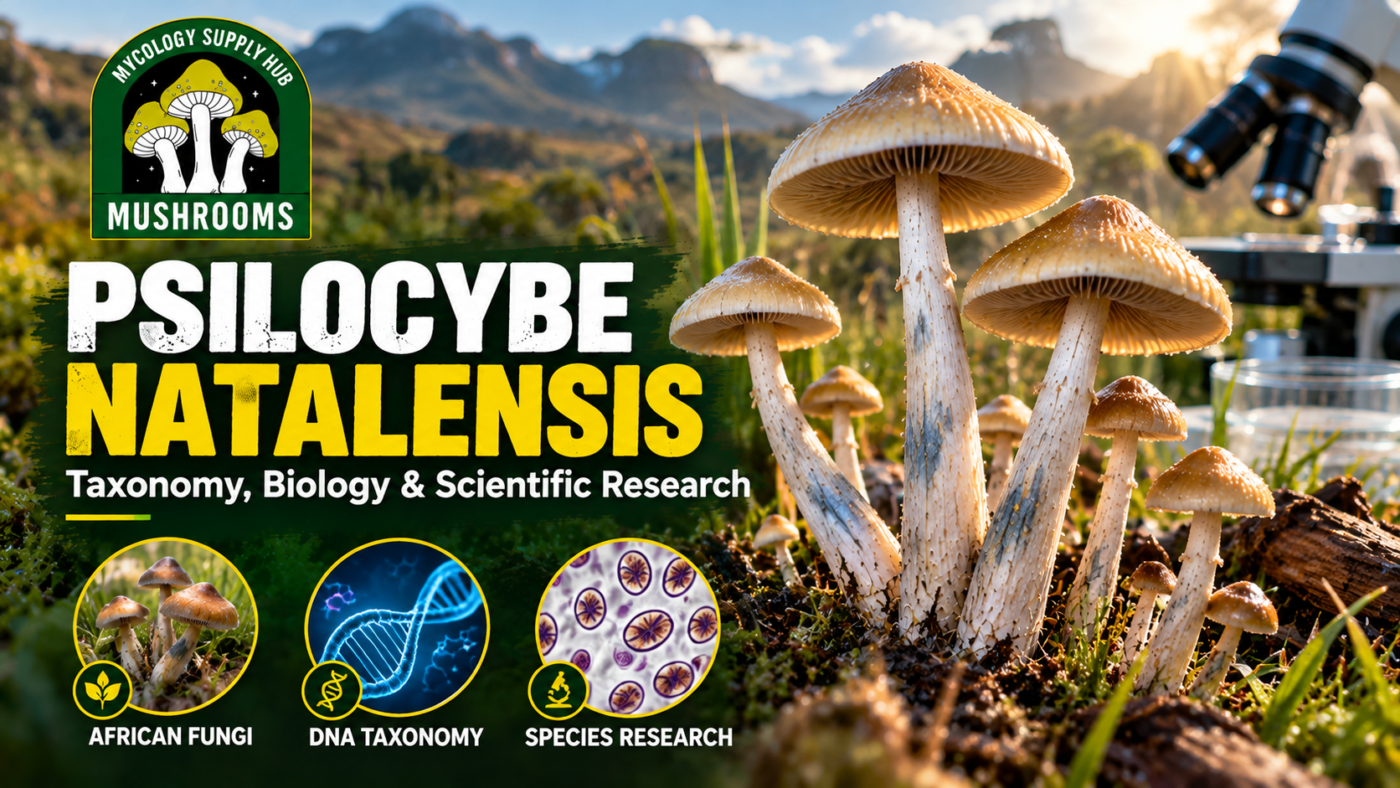
Psilocybe Natalensis: A Complete Scientific Guide to Its Biology and Taxonomy
Oct
Psilocybe natalensis is a species of psilocybin-containing mushroom originally described from South Africa. It belongs to the genus Psilocybe, a group of fungi studied for their evolutionary relationships, ecological diversity and naturally occurring chemical compounds.
The species has become widely discussed among mycology enthusiasts, particularly because of its historical association with the KwaZulu-Natal region and its perceived similarities to Psilocybe cubensis.
However, modern genetic research has revealed an important complication: not every specimen marketed or described as Psilocybe natalensis belongs to that species.
In this educational guide, Mycology Supply Hub examines its discovery, taxonomy, biological characteristics and significance in modern fungal science.
2. What Is Psilocybe Natalensis?
Psilocybe natalensis is a mushroom species first formally described in 1995 by Jochen Gartz, Derek Reid, Michael Smith and Albert Eicker.
The name natalensis references Natal, the historical geographical name associated with the South African region where its original specimens were documented.
The species remains recorded under its original scientific name in Index Fungorum, a recognised fungal nomenclature database.
Name Record
Scientific classification
| Taxonomic rank | Classification |
|---|---|
| Kingdom | Fungi |
| Phylum | Basidiomycota |
| Class | Agaricomycetes |
| Order | Agaricales |
| Genus | Psilocybe |
| Species | Psilocybe natalensis |
| Described | 1995 |
The scientific name identifies a particular species rather than a general category of psychedelic mushrooms.
This distinction matters because closely related fungi can resemble one another while possessing different genetic histories and taxonomic identities.
3. The South African Origins of Psilocybe Natalensis
The original species description was associated with KwaZulu-Natal, South Africa.
The type specimen was documented from nutrient-rich pasture soil, providing an important ecological record for the taxon.
Name record
Africa’s fungal biodiversity remains incompletely documented, meaning that historical collections and modern investigations can reveal important information about species that have received relatively little scientific attention.
Why geographical origins matter
Geographical records help researchers understand:
- The historical distribution of fungal species.
- Relationships between fungi and regional environments.
- Patterns of evolutionary diversification.
- Possible errors in older species-identification records.
- The need to preserve fungal specimens for future research.
A mushroom’s geographic association is useful scientific information, but location alone cannot establish species identity.
4. Psilocybe Natalensis vs Psilocybe Ochraceocentrata
This is the most important recent development concerning P. natalensis.
In research published by the Royal Society, scientists examined DNA evidence from historical specimens and modern fungal collections.
They established Psilocybe ochraceocentrata as a distinct species and found that several samples previously labelled P. natalensis, including material associated with the informal name Natal Super Strength, matched the newly described species rather than the original P. natalensis type material.
The Royal Society
What does this discovery mean?
It means Psilocybe natalensis and Psilocybe ochraceocentrata should not automatically be treated as synonyms.
The original P. natalensis remains a recognised taxonomic name, while P. ochraceocentrata represents a separate species established using modern scientific evidence.
Comparison
| Feature | P. natalensis | P. ochraceocentrata |
|---|---|---|
| Scientific description | 1995 | 2026 |
| Original type locality | KwaZulu-Natal, South Africa | Zimbabwe |
| Genus | Psilocybe | Psilocybe |
| Species status | Distinct recognised taxon | Distinct recognised taxon |
| Genetic relationship | Separate lineage | Close relative of P. cubensis |
| Naming issue | Frequently misapplied | Some specimens previously labelled natalensis belong here |
This distinction demonstrates why current scientific literature should take priority over informal marketplace terminology.
5. Physical and Microscopic Biology
Like other gilled basidiomycete fungi, Psilocybe natalensis forms reproductive structures known as fruiting bodies.
These structures are commonly referred to as mushrooms.
Mushroom cap
The cap, scientifically called the pileus, protects the developing spore-bearing structures.
Its shape and appearance can change as a fruiting body matures.
Gills
The gills, also known as lamellae, contain structures involved in the production of reproductive spores.
Stem
The stem, or stipe, supports the mushroom cap and helps position the reproductive structures.
Spores
Spores are microscopic reproductive units that contribute to the fungal life cycle.
Microscopic spore characteristics can support scientific classification, although no single characteristic is sufficient for definitive identification.
Mycelium
Mycelium consists of interconnected fungal filaments called hyphae.
This network performs essential functions associated with nutrient acquisition and fungal growth.
Scientific note: Because some published descriptions may involve mislabelled specimens, the identity of the underlying reference material is crucial when comparing P. natalensis characteristics.
6. How DNA Research Is Changing Mushroom Taxonomy
Historically, mycologists often relied heavily on visible and microscopic characteristics when distinguishing mushroom species.
These characteristics remain important, but modern taxonomic investigations increasingly incorporate genetic analysis.
DNA barcoding
DNA barcoding involves examining specific genetic regions to compare organisms.
For fungi, the internal transcribed spacer region, commonly abbreviated ITS, is frequently used as a molecular identification marker.
Type specimens
A type specimen provides a permanent reference associated with the formal description of a scientific name.
Comparing newer material with authenticated type specimens helps avoid mistakes caused by informal naming conventions.
Phylogenetic analysis
Phylogenetics examines evolutionary relationships among organisms.
Using genetic evidence, researchers can investigate how different fungal lineages are related.
The research describing P. ochraceocentrata used multiple molecular markers and comparisons with historical reference specimens, helping expose previous identification errors.
NCBI
+1
7. Psilocybe Natalensis vs Psilocybe Cubensis
Psilocybe cubensis is one of the most widely studied species in the genus Psilocybe.
Both names appear frequently in discussions of fungal genetics and natural chemical compounds.
However, shared membership in the same genus does not make them the same organism.
| Characteristic | Psilocybe natalensis | Psilocybe cubensis |
|---|---|---|
| Genus | Psilocybe | Psilocybe |
| Kingdom | Fungi | Fungi |
| Natural compound of interest | Psilocybin | Psilocybin |
| Scientific naming history | Described in 1995 | Originally described in 1906 |
| Taxonomic research | Reference-specimen comparisons | Genetics, evolutionary biology and chemistry |
| Identification | Requires reliable evidence | Requires reliable evidence |
The 2026 research also found that P. ochraceocentrata is particularly closely related to P. cubensis. That relationship should not simply be attributed to true P. natalensis.
The Royal Society
8. Natural Chemical Compounds and Research Interest
Members of the genus Psilocybe have been studied for their production of psilocybin and related tryptamine compounds.
Psilocybin
Psilocybin is a naturally occurring chemical compound that can be converted into psilocin in the human body.
Psilocin
Psilocin acts on serotonin signalling pathways and contributes to alterations in perception and cognition.
Why species verification matters
Different fungal species, and even individual specimens, can differ in chemical composition.
If a scientific study uses an incorrectly labelled mushroom specimen, its findings may be attributed to the wrong species.
This can affect the reliability and reproducibility of chemical, genetic and biological research.
The need for accurate species verification is one of the major lessons of recent work on African Psilocybe fungi.
9. Why Psilocybe Natalensis Matters to Modern Mycology
The scientific importance of P. natalensis extends beyond its chemical characteristics.
Biodiversity research
Accurate species documentation helps scientists understand fungal diversity across southern Africa.
Evolutionary biology
Comparing fungal lineages can reveal how closely related species diversified.
Museum collections
Historical fungal specimens preserve scientific information that can become even more valuable as technology improves.
Scientific naming standards
The distinction between P. natalensis and P. ochraceocentrata illustrates the importance of maintaining accurate taxonomy.
Research transparency
Clearly reporting how a specimen was identified helps other scientists assess the reliability of published findings.
10. Safety and Legal Considerations
Psilocybin-containing mushrooms may produce unpredictable psychological and physiological effects, including anxiety, confusion and changes in perception.
They can also be mistaken for toxic mushroom species.
Identification should not be attempted for consumption using photographs, informal variety names or short online descriptions.
In the United States, psilocybin remains a federally controlled substance, while state and local laws vary.
Scientific research and regulatory decisions should be distinguished from unsupported claims about medical benefits.
11. Frequently Asked Questions
1. What is Psilocybe natalensis?
It is a species of psilocybin-containing fungus first formally described from South Africa in 1995.
2. Where did Psilocybe natalensis originate?
Its type locality is in KwaZulu-Natal, South Africa.
3. Is Psilocybe natalensis the same as Psilocybe cubensis?
No. They have separate scientific names and distinct taxonomic identities.
4. Is Psilocybe ochraceocentrata another name for Psilocybe natalensis?
No. Recent genetic research established P. ochraceocentrata as a separate species and found that some specimens labelled natalensis had been misidentified.
5. What is Natal Super Strength?
It is an informal name used for some mushroom material historically associated with P. natalensis. The label alone does not prove scientific species identity.
6. Why is DNA sequencing important for mushroom identification?
Genetic evidence can distinguish closely related organisms that may appear similar.
7. Are mushroom spores important to scientists?
Yes. Spores are involved in fungal reproduction, and their microscopic characteristics can provide taxonomic evidence.
8. Can a mushroom’s scientific identity be confirmed from a photograph?
Not reliably. Accurate classification may require microscopy, authenticated reference material and molecular analysis.
9. Why was the 2026 research significant?
It demonstrated the existence of a distinct African Psilocybe species and identified errors in previously assigned species names.
10. Why should readers care about mushroom taxonomy?
Accurate taxonomy supports reliable research, biodiversity monitoring and clearer scientific communication.
12. Conclusion
Psilocybe natalensis remains an important subject for understanding African fungal biodiversity and the scientific classification of psilocybin-containing mushrooms.
Recent research provides an especially useful lesson: names used in informal communities do not always correspond to verified biological species.
As molecular tools improve, researchers can revisit historical collections, identify taxonomic errors and build a more accurate understanding of fungal evolution.
For more educational articles about mushroom science, visit Mycology Supply Hub.
